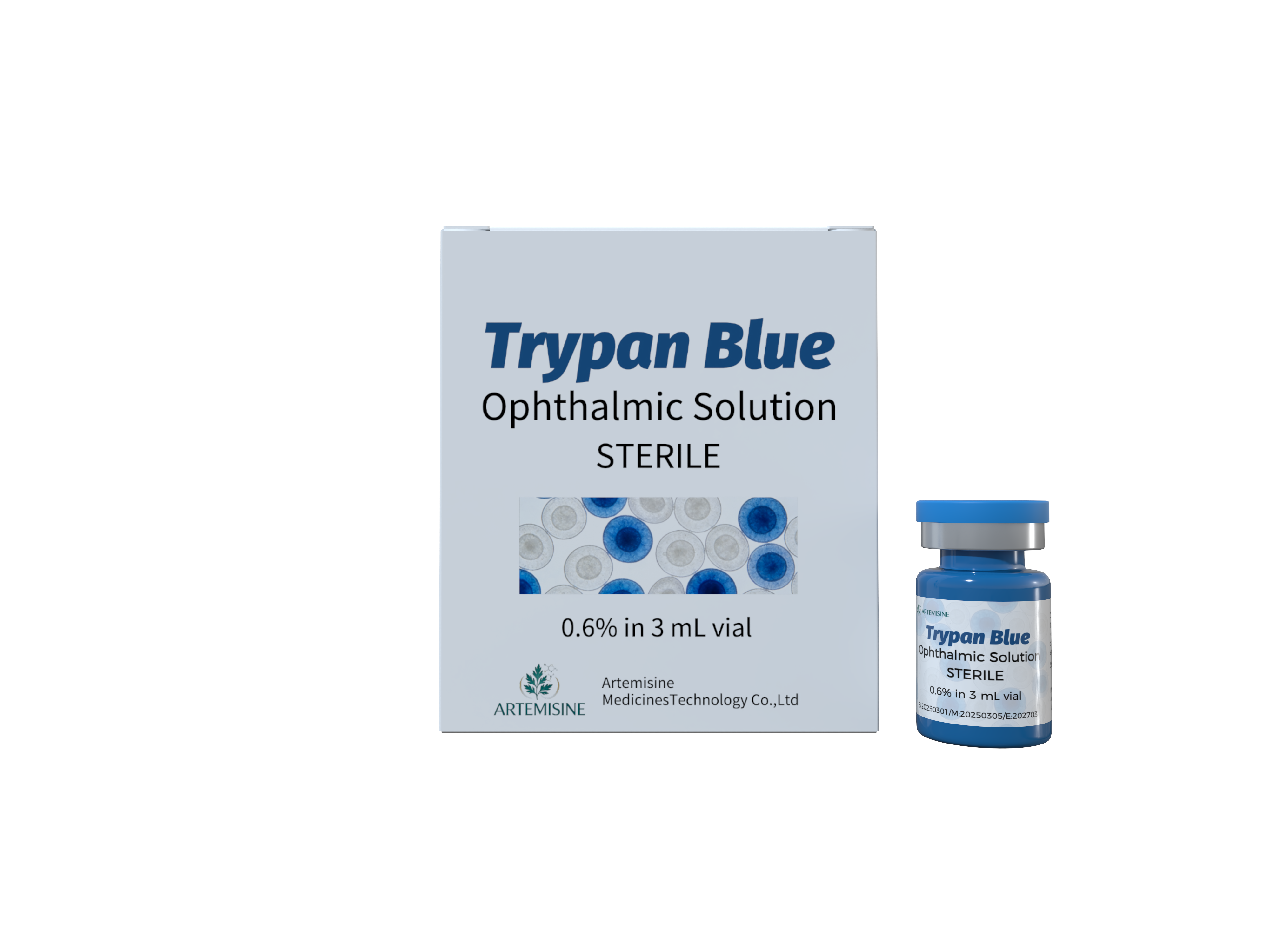
Trypan Blue Ophthalmic Solution

This document describes the composition, intended use and correct handling of Trypan Blue Ophthalmic Solution 0.6% (3 mL). The product is a

Trypan Blue Ophthalmic Solution product packaging
Ophthalmic

Trypan Blue Ophthalmic Solution

This document describes the composition, intended use and correct handling of Trypan Blue Ophthalmic Solution 0.6% (3 mL). The product is a sterile surgical staining solution for intraocular use by qualified ophthalmic surgeons only. It is not intended for self-administration. For full prescribing information, always refer to the approved package insert of the product and to the manufacturer’s labelling.

Product NameTrypan Blue Ophthalmic Solution
Dosage FormOphthalmic
Strength0.6% (6 mg/mL)
StandardsBP / ENTERPRISE
PackingCustomized per market requirement (bottle / blister / box)
DocumentsCOA, COPP, DMF, CTD Dossiers
MOQContact us for MOQ and current stock
Request Quotation › ← Back to Ophthalmic
WHO Prescribing Guidance

Indications · Administration · Dosage · Precautions

Reference information summarised from WHO prescribing guidance. Expand each item below — clinical use must always follow the locally approved product insert.

🎯Indications▾
Trypan Blue Ophthalmic Solution 0.6% is indicated for use as an aid in ophthalmic surgery by staining the anterior capsule of the lens, facilitating visualisation and creation of the capsulorhexis during cataract surgery, in particular in mature or white cataracts where the capsular edge is difficult to see [1][2]. In established ophthalmic practice, trypan blue solutions are also used to stain ocular tissues during vitreoretinal surgery; suitability for such use should be confirmed against the applicable registration and labelling of the product in the country concerned [2].
💧Administration▾
For intraocular use only, by qualified ophthalmic surgeons under sterile operating conditions. The product is not for self-administration and not for repeated or long-term use [2]. During cataract surgery, the following procedure is followed [1]: 1. After opening the eye, an air bubble is injected into the anterior chamber in order to minimise dilution of the dye by the aqueous humour. 2. The solution is carefully applied onto the anterior lens capsule using a blunt cannula. 3. Sufficient staining is achieved as soon as the dye has contacted the capsule. 4. The anterior chamber is then irrigated with balanced salt solution to remove all excess dye. 5. An anterior capsulotomy (capsulorhexis) can then be performed. All excess dye must be removed from the eye immediately after staining [1].
⚖️Dosage▾
The volume to be used is determined by the surgeon according to the surgical technique; a quantity sufficient to cover the anterior lens capsule (typically a few drops) is instilled into the anterior chamber at the surgeon’s discretion [1]. The product is for single use. Any unused remainder must be discarded after opening, in accordance with the labelling; the container must not be reused for another patient or another procedure [2].
⚠️Precautions & Warnings▾
● The solution must not be used if a non-hydrated (dry state) hydrophilic acrylic intraocular lens (IOL) is planned for insertion into the eye, as the dye may be absorbed by the IOL and stain it [1]. ● All excess dye must be removed immediately after staining by thorough irrigation of the anterior chamber [1]. ● Use strict aseptic technique. The product is for intraocular use only; do not use by any other route. ● Do not use if the solution is not a clear, dark blue liquid, or if it is cloudy, contains particles, or the container is damaged. ● Reported adverse reactions include inadvertent staining of the posterior lens capsule and vitreous face, which is generally self-limited and lasts up to one week, and discolouration of high-water-content hydrogel IOLs [1]. ● When used as recommended, systemic absorption is expected to be negligible; use in pregnancy and lactation should follow the surgeon’s clinical judgement and the approved labelling [1]. ● Store between 15 °C and 25 °C, protected from light (direct sunlight); keep in the original container and do not freeze [1][2]. ● Keep out of the reach of children. For professional use only. ● Dispose of unused product and containers in accordance with local regulations. This document is a customer information summary. The complete prescribing information, including composition, indications, contraindications, dosage and adverse effects, is provided in the approved package insert and product labelling of the product concerned.

Reference: WHO Model Formulary / WHO Model List of Essential Medicines. For professional reference only — clinical use must follow the locally approved product insert and national treatment guidelines.

Why Order From Us

Factory Direct. Fully Documented.

🛡️

GMP Quality

Full batch testing and quality traceability under standard GMP workshops.

🚢

Fast Delivery

Sufficient stock on regular items, familiar with export logistics to 50+ countries.

📑

Registration Support

COA, DMF, dossier and legalization documents for your market registration.

FAQ

Trypan Blue Ophthalmic Solution — Frequently Asked Questions

Which documents are provided for Trypan Blue Ophthalmic Solution registration?

Every batch of Trypan Blue Ophthalmic Solution ships with a Certificate of Analysis (COA). For market registration we provide COPP, DMF and CTD-format dossiers, plus legalisation support where your authority requires it.

What is the MOQ and lead time for Trypan Blue Ophthalmic Solution?

MOQ and lead time for Trypan Blue Ophthalmic Solution depend on strength, packaging and destination market. Send us your target market and annual volume — our export team confirms current stock, MOQ and lead time within 24 hours.

Do you support OEM / private label?

Yes. We offer OEM packaging and private-label production for Trypan Blue Ophthalmic Solution, subject to the regulatory requirements of the destination market.

Which markets have you exported ophthalmic products to?

We have supplied ophthalmic products to 50+ countries across Africa, Southeast Asia, Latin America and the Middle East, with experience in ministry-of-health registration and international tenders.

How is the quality of Trypan Blue Ophthalmic Solution controlled?

Trypan Blue Ophthalmic Solution is produced in China-GMP workshops (site re-inspected and passed in 2026), released only after full QC testing against BP / enterprise standards, with retained samples kept for one year beyond the product's expiry date.

Ask About This Product ›
✎ 💬 ↑
👋 Hi! I'm Care, your product guide. Tap me to ask about our medicines & APIs. ×
Care - product guide assistant