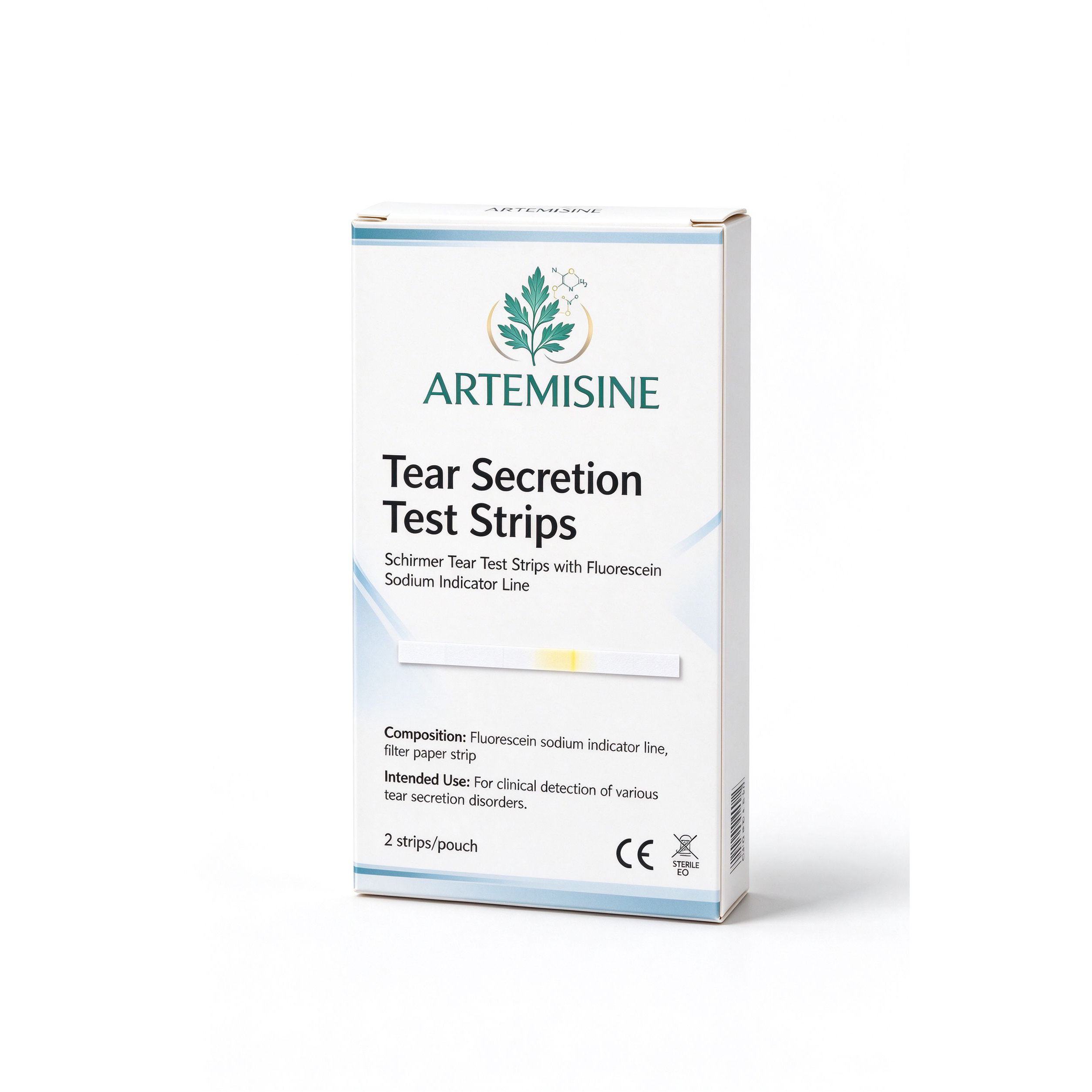
Tear Secretion Test Filter Paper (Schirmer Tear Test Strips)

● Absorbent filter paper strip (Whatman filter paper No. 41), approximately 5 mm wide and 35 mm long, supplied sterile for single use [1][2]

Tear Secretion Test Filter Paper (Schirmer Tear Test Strips) product packaging
Ophthalmic Diagnostics

Tear Secretion Test Filter Paper (Schirmer Tear Test Strips)

● Absorbent filter paper strip (Whatman filter paper No. 41), approximately 5 mm wide and 35 mm long, supplied sterile for single use [1][2][3]
● Rounded wick end for patient contact; the strip is folded at the notch (about 5 mm from the rounded end) before placement [1][2]
● Millimetre scale printed on the strip (0–35 mm, 1 mm graduations) for measuring the moistened length; some versions carry a blue indicator dye (FD&C Blue No. 1) that wicks up the scale to improve visibility [2][3]
● Sterilised by gamma irradiation (or ethylene oxide), individually wrapped in a sterile pouch [2][3]
● Pack structure: 2 strips per pouch, 10 pouches per small box; reference packs contain 25–100 strips per box — pack configuration may vary by product and market [2][3]

Product NameTear Secretion Test Filter Paper (Schirmer Tear Test Strips)
Dosage FormDiagnostic
Strength2 pics/box
StandardsBP / ENTERPRISE
Packing2 pic/ box
DocumentsCOA, COPP, DMF, CTD Dossiers
MOQContact us for MOQ and current stock
Request Quotation › ← Back to Ophthalmic Diagnostics
WHO Prescribing Guidance

Indications · Administration · Dosage · Precautions

Reference information summarised from WHO prescribing guidance. Expand each item below — clinical use must always follow the locally approved product insert.

🎯Indications▾
● Evaluation of tear production in patients with suspected keratoconjunctivitis sicca (dry eye) [1][2][3] ● Assessment of the aqueous component of the ocular tear film and identification of aqueous tear deficiency, e.g. in Sjögren’s syndrome or other lacrimal gland dysfunction [2][3] ● Evaluation of a patient’s suitability for wearing contact lenses [2] ● Suitable for patients of any gender, ethnicity or age after medical assessment [2][3]
💧Administration▾
● To be performed by a qualified, trained ophthalmic healthcare professional (ophthalmologist, optometrist, ophthalmic technician, nurse or emergency physician) [2][3] ● Perform the test before any other intervention involving the eye; do not apply topical medication to the eye or manipulate the eye beforehand [2][3] ● Seat the patient comfortably with dimmed room lighting; the examiner should wash hands and ideally wear protective medical gloves [1][2][3] ● Open the pouch carefully without touching the rounded wick end; bend the wick end at the marked notch/V indentation to form a right angle [1][2][3] ● Ask the patient to look upward, gently pull down the lower eyelid, and place the bent end on the lower fornix (at the junction of the middle and outer thirds of the lower eyelid) so that the bend overlaps the lid margin; avoid touching the cornea, as this invalidates the result [1][2][3] ● Test both eyes at the same time, using one strip per eye; start the timer once both strips are in place [1][2][3] ● Ask the patient to keep the eyes gently closed (without squeezing) for 5 minutes; then remove the strips and measure the moistened length in millimetres separately for each eye [1][2][3]
⚖️Dosage▾
One sterile strip per eye for a single 5-minute measurement; each strip is for single use only and must be discarded after the test [2][3]. When performed with topical anaesthesia (Schirmer II test, basal secretion), >10 mm of wetting is considered normal [2]. Use one strip per eye; do not reuse [2][3].
⚠️Precautions & Warnings▾
● Single-use device: do not reuse or re-sterilise — reuse can transmit contagious and communicable diseases (e.g. conjunctivitis viruses, hepatitis B and C, HIV) and cause serious patient harm [2][3] ● Use one strip per eye to prevent possible microbial cross-contamination between the patient’s eyes [2] ● Contraindicated when the patient has just received eye drops, and where medical assessment deems use unsafe (e.g. active ocular infection, disease or trauma, corneal surgery or injury, ruptured globe, unhealed corneal abrasions or ulcers, corneal scars, patients with special needs) [2][3] ● Do not use in patients with hypersensitivity to any component of the device; contraindicated in ocular surface damage, inflammation, or ulcers of the cornea and conjunctiva [3] ● Do not use if the sterile pouch is open or damaged — sterility is only guaranteed when the packaging is unopened and undamaged; do not use after the sterility expiry date [2][3] ● Do not touch the rounded wick end; avoid contact between the strip and the cornea [2][3] ● The test may cause anxiety before and during the procedure, and pain, irritation, itching, tearing or other eye discomfort; infection and inflammation are also possible [2] ● The Schirmer test should not be the sole test for diagnosing dry eye disease — use in conjunction with other diagnostic procedures [2] ● Excessive irritation during placement may trigger reflex tearing and compromise the result; topical anaesthetics may be used if necessary [1][2] ● Storage: keep in a clean, dry place, away from direct sunlight (per one IFU: 5–55 °C, 55–75% relative humidity); do not use if packaging is damaged or soiled [2][3] ● Dispose of the used strip and pouch in compliance with local clinical waste procedures; keep out of the reach of children [2][3] For full information, refer to the approved instructions for use and clinical references of the product concerned [1][2][3].

Reference: WHO Model Formulary / WHO Model List of Essential Medicines. For professional reference only — clinical use must follow the locally approved product insert and national treatment guidelines.

Why Order From Us

Factory Direct. Fully Documented.

🛡️

GMP Quality

Full batch testing and quality traceability under standard GMP workshops.

🚢

Fast Delivery

Sufficient stock on regular items, familiar with export logistics to 50+ countries.

📑

Registration Support

COA, DMF, dossier and legalization documents for your market registration.

FAQ

Tear Secretion Test Filter Paper (Schirmer Tear Test Strips) — Frequently Asked Questions

Which documents are provided for Tear Secretion Test Filter Paper (Schirmer Tear Test Strips) registration?

Every batch of Tear Secretion Test Filter Paper (Schirmer Tear Test Strips) ships with a Certificate of Analysis (COA). For market registration we provide COPP, DMF and CTD-format dossiers, plus legalisation support where your authority requires it.

What is the MOQ and lead time for Tear Secretion Test Filter Paper (Schirmer Tear Test Strips)?

MOQ and lead time for Tear Secretion Test Filter Paper (Schirmer Tear Test Strips) depend on strength, packaging and destination market. Send us your target market and annual volume — our export team confirms current stock, MOQ and lead time within 24 hours.

Do you support OEM / private label?

Yes. We offer OEM packaging and private-label production for Tear Secretion Test Filter Paper (Schirmer Tear Test Strips), subject to the regulatory requirements of the destination market.

Which markets have you exported ophthalmic diagnostics products to?

We have supplied ophthalmic diagnostics products to 50+ countries across Africa, Southeast Asia, Latin America and the Middle East, with experience in ministry-of-health registration and international tenders.

How is the quality of Tear Secretion Test Filter Paper (Schirmer Tear Test Strips) controlled?

Tear Secretion Test Filter Paper (Schirmer Tear Test Strips) is produced in China-GMP workshops (site re-inspected and passed in 2026), released only after full QC testing against BP / enterprise standards, with retained samples kept for one year beyond the product's expiry date.

Ask About This Product ›
✎ 💬 ↑
👋 Hi! I'm Care, your product guide. Tap me to ask about our medicines & APIs. ×
Care - product guide assistant