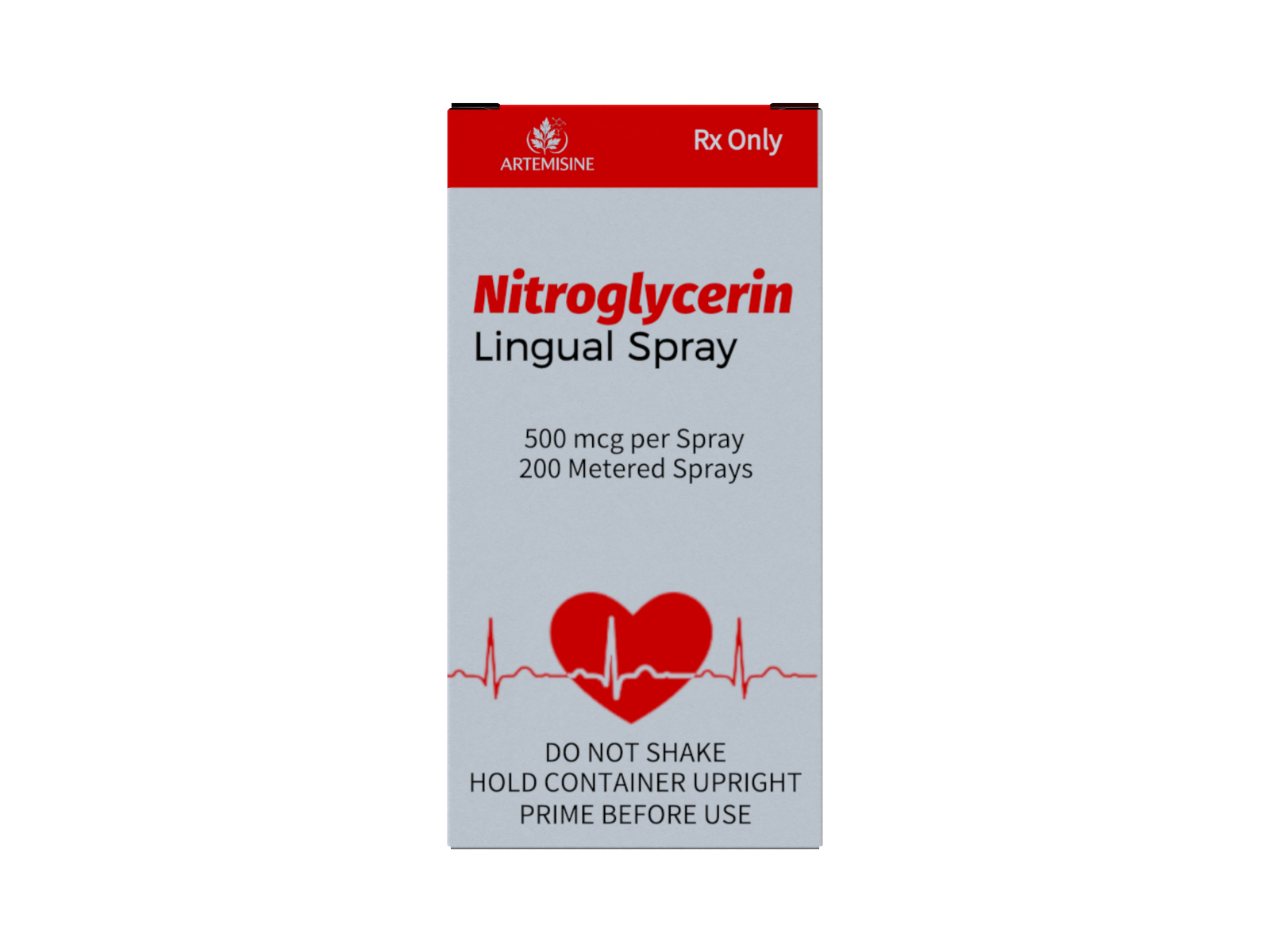
Nitroglycerin Lingual Spray (500 mcg per Spray, 200 Sprays)

Metered-dose lingual spray delivering nitroglycerin 500 mcg per spray; 200 metered sprays per pressurised canister [2]. Nitroglycerin (glyc

Nitroglycerin Lingual Spray (500 mcg per Spray, 200 Sprays) product packaging
Syrups

Nitroglycerin Lingual Spray (500 mcg per Spray, 200 Sprays)

Metered-dose lingual spray delivering nitroglycerin 500 mcg per spray; 200 metered sprays per pressurised canister [2].
Nitroglycerin (glyceryl trinitrate) is an organic nitrate; 1,2,3-propanetriol trinitrate (C3H5N3O9, molecular weight 227.09) [2].
Nitroglycerin releases nitric oxide, activating guanylate cyclase and raising cyclic GMP in smooth muscle, relaxing arteries and veins; venous (preload) effects predominate, with afterload reduction and dilatation of epicardial coronary arteries [1][2].
Rapidly absorbed through the buccal/sublingual mucosa; peak plasma within about 4 minutes; bioavailability about 39%; plasma half-life 1-3 minutes; active dinitrate metabolites prolong the effect [1][2].
Contains ethanol - 7.5 mg per spray (UK) or about 20% alcohol (US) - plus peppermint oil and other excipients [1][2].

Product NameNitroglycerin Lingual Spray (500 mcg per Spray, 200 Sprays)
Dosage FormSpray
Strength500 mcg per Spray, 200 Sprays
StandardsBP / ENTERPRISE
Packing1 pic/ box
DocumentsCOA, COPP, DMF, CTD Dossiers
MOQContact us for MOQ and current stock
Request Quotation › ← Back to Syrups
WHO Prescribing Guidance

Indications · Administration · Dosage · Precautions

Reference information summarised from WHO prescribing guidance. Expand each item below — clinical use must always follow the locally approved product insert.

🎯Indications▾
Treatment of acute attacks of angina pectoris due to coronary artery disease [1][2][3]. Prophylaxis of angina induced by physical effort, emotional stress or exposure to cold, or before activities likely to precipitate an attack [1][2][3]. Not recommended in children and adolescents under 18 years (UK labelling) [1].
💧Administration▾
Spray one or two metered doses onto or under the tongue at the onset of an attack, or 5-10 minutes (US) / 2-3 minutes (UK) before an activity likely to cause angina [1][2][3]. Rest, preferably sitting; hold the container upright, valve uppermost, orifice close to the mouth; close the mouth immediately after each dose [1][2][3]. Do not inhale the spray; do not spit out or rinse the mouth for 5-10 minutes after administration [2][3]. Prime before first use until a fine mist appears; re-prime after 6 weeks without use (1 spray) and after 3 months (up to 5 sprays) [2][3]. Storage: do not store above 25 °C (UK) or store at 20-25 °C (US); do not refrigerate or freeze; do not pierce or burn the pressurised canister or spray towards a naked flame; keep out of the reach of children [1][2][3].
⚖️Dosage▾
Dosage is expressed per spray; use the smallest number of sprays that gives relief to limit tolerance [1][2][3]. For the 500 mcg per spray product, the number of sprays per dose follows the approved product labelling [1][2].
⚠️Precautions & Warnings▾
Contraindicated with phosphodiesterase-5 inhibitors (sildenafil, tadalafil, vardenafil, avanafil) and with the soluble guanylate cyclase stimulator riociguat - severe hypotension, syncope or myocardial ischaemia may occur [1][2]. Also contraindicated in severe anaemia, increased intracranial pressure, hypersensitivity, acute circulatory failure or shock, severe hypotension (systolic below 90 mm Hg), constrictive pericarditis, aortic or mitral stenosis, and angina caused by hypertrophic obstructive cardiomyopathy [1][2]. Severe hypotension may occur even with small doses, especially on standing or in volume-depleted patients; paradoxical bradycardia and increased angina may accompany it [1][2]. Tolerance and cross-tolerance to other nitrates develop with excessive or continuous high-dose use; use the smallest effective number of sprays [1][2]. Headache is common and dose-related, especially at the start of therapy; flushing, dizziness and paresthesia are also reported [1][2][3]. Caution in pericardial tamponade, low filling pressures (acute myocardial infarction, left ventricular failure), orthostatic dysregulation, raised intracranial pressure, glaucoma, volume depletion from diuretics, severe hepatic or renal impairment and hypothyroidism [1]. Interactions: alcohol, antihypertensives, beta-blockers, calcium antagonists, vasodilators, tricyclic antidepressants and diuretics potentiate hypotension; avoid ergotamine; monitor heparin; high-dose aspirin increases nitroglycerin exposure [1][2]. Pregnancy: limited data are insufficient to establish risk; animal studies showed no adverse developmental effects at over 64 times the human dose - use only if clearly needed. Breast-feeding: excretion into milk is unknown; weigh benefit against risk [1][2]. Driving and machinery: the ability to react may be reduced; avoid driving or operating machines during treatment [1]. Other adverse reactions: syncope, orthostatic hypotension, tachycardia or bradycardia, nausea and vomiting, application-site burning or stinging, rash and exfoliative dermatitis, transient hypoxaemia [1][2][3]. Overdose: severe hypotension, throbbing headache, vertigo, palpitation, flushing, nausea and vomiting, syncope and rarely methemoglobinaemia; treatment - recumbent shock position, leg elevation, fluids, oxygen and intravenous methylthioninium chloride 1-2 mg/kg (avoid in G6PD deficiency); epinephrine is not recommended [1][2][3]. Prescription medicine (Rx only in the US; POM in the UK) [1][2]. For full prescribing information, refer to the approved product label [1][2][3].

Reference: WHO Model Formulary / WHO Model List of Essential Medicines. For professional reference only — clinical use must follow the locally approved product insert and national treatment guidelines.

Why Order From Us

Factory Direct. Fully Documented.

🛡️

GMP Quality

Full batch testing and quality traceability under standard GMP workshops.

🚢

Fast Delivery

Sufficient stock on regular items, familiar with export logistics to 50+ countries.

📑

Registration Support

COA, DMF, dossier and legalization documents for your market registration.

FAQ

Nitroglycerin Lingual Spray (500 mcg per Spray, 200 Sprays) — Frequently Asked Questions

Which documents are provided for Nitroglycerin Lingual Spray (500 mcg per Spray, 200 Sprays) registration?

Every batch of Nitroglycerin Lingual Spray (500 mcg per Spray, 200 Sprays) ships with a Certificate of Analysis (COA). For market registration we provide COPP, DMF and CTD-format dossiers, plus legalisation support where your authority requires it.

What is the MOQ and lead time for Nitroglycerin Lingual Spray (500 mcg per Spray, 200 Sprays)?

MOQ and lead time for Nitroglycerin Lingual Spray (500 mcg per Spray, 200 Sprays) depend on strength, packaging and destination market. Send us your target market and annual volume — our export team confirms current stock, MOQ and lead time within 24 hours.

Do you support OEM / private label?

Yes. We offer OEM packaging and private-label production for Nitroglycerin Lingual Spray (500 mcg per Spray, 200 Sprays), subject to the regulatory requirements of the destination market.

Which markets have you exported syrups products to?

We have supplied syrups products to 50+ countries across Africa, Southeast Asia, Latin America and the Middle East, with experience in ministry-of-health registration and international tenders.

How is the quality of Nitroglycerin Lingual Spray (500 mcg per Spray, 200 Sprays) controlled?

Nitroglycerin Lingual Spray (500 mcg per Spray, 200 Sprays) is produced in China-GMP workshops (site re-inspected and passed in 2026), released only after full QC testing against BP / enterprise standards, with retained samples kept for one year beyond the product's expiry date.

Ask About This Product ›
✎ 💬 ↑
👋 Hi! I'm Care, your product guide. Tap me to ask about our medicines & APIs. ×
Care - product guide assistant