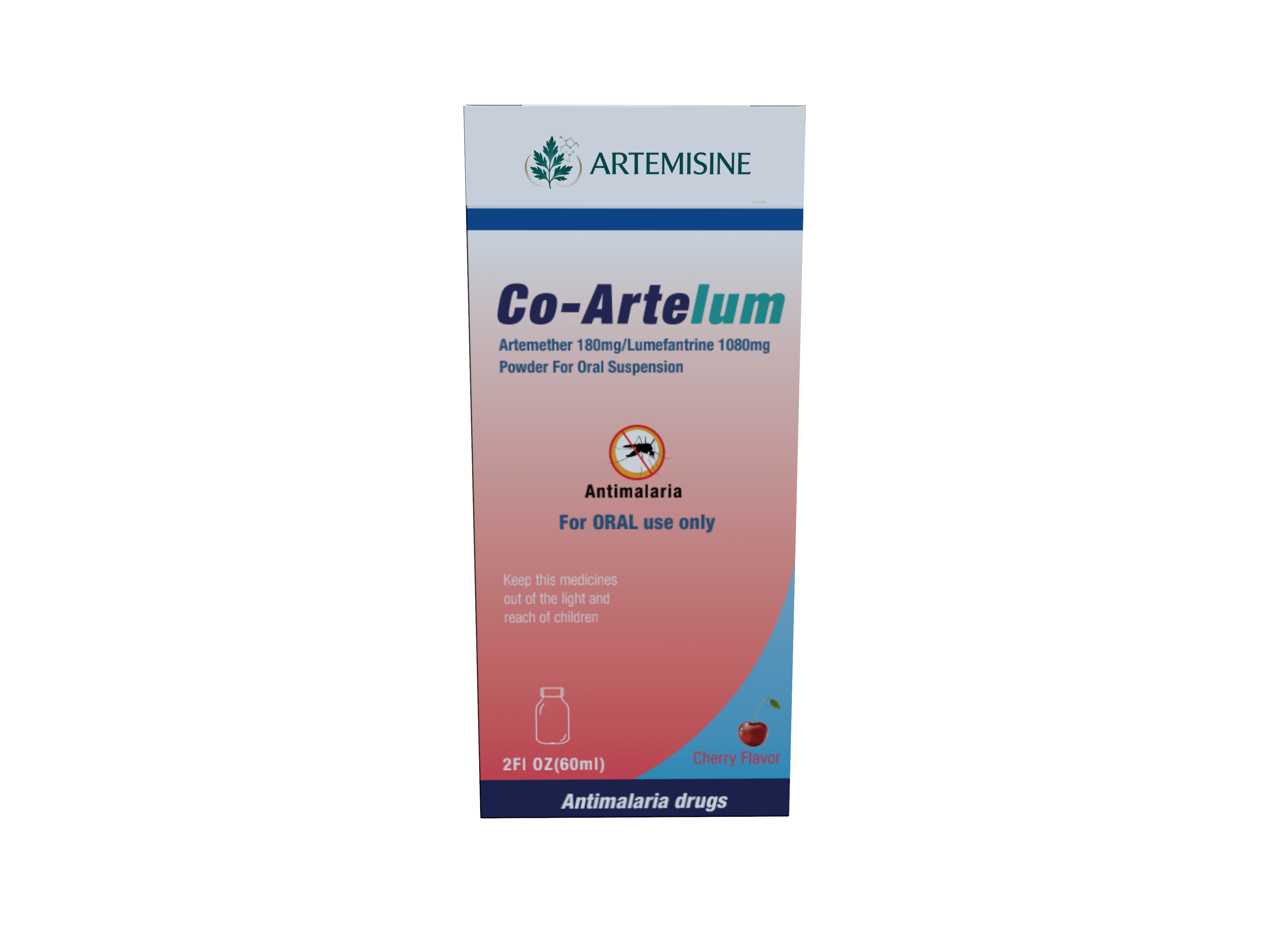
Artemether/Lumefantrine Oral Suspension (Artemether 180 mg + Lumefantrine 1080 mg per 60 mL)

● Fixed-dose combination oral suspension: artemether 15 mg + lumefantrine 90 mg per 5 mL (fixed 1:6 ratio); a 60 mL bottle provides artemeth

Artemether/Lumefantrine Oral Suspension (Artemether 180 mg + Lumefantrine 1080 mg per 60 mL) product packaging
Suspensions

Artemether/Lumefantrine Oral Suspension (Artemether 180 mg + Lumefantrine 1080 mg per 60 mL)

● Fixed-dose combination oral suspension: artemether 15 mg + lumefantrine 90 mg per 5 mL (fixed 1:6 ratio); a 60 mL bottle provides artemether 180 mg + lumefantrine 1080 mg [1][2][3]
● Artemether is an artemisinin derivative (empirical formula C16H26O5, molecular weight 298.4); lumefantrine has the empirical formula C30H32Cl3NO (molecular weight 528.9); both components are blood schizontocides [2]
● Mechanism: both components act in the parasite food vacuole, interfering with the conversion of haem to haemozoin, and inhibit nucleic acid and protein synthesis [1][2]
● Artemether is rapidly metabolised to the active metabolite dihydroartemisinin (DHA); lumefantrine is slowly eliminated with a half-life of 3–6 days [1][2]
● Food greatly enhances absorption of both drugs (artemether 2- to 3-fold, lumefantrine up to 16-fold with a fatty meal) [1][2]
● The registered tablet reference (Riamet/Coartem) contains artemether 20 mg and lumefantrine 120 mg per tablet [1][2]

Product NameArtemether/Lumefantrine Oral Suspension (Artemether 180 mg + Lumefantrine 1080 mg per 60 mL)
Dosage Formsuspension
StrengthArtemether 180 mg + Lumefantrine 1080 mg per 60 mL
StandardsBP / ENTERPRISE
Packing1 pic/ box
DocumentsCOA, COPP, DMF, CTD Dossiers
MOQContact us for MOQ and current stock
Request Quotation › ← Back to Suspensions
WHO Prescribing Guidance

Indications · Administration · Dosage · Precautions

Reference information summarised from WHO prescribing guidance. Expand each item below — clinical use must always follow the locally approved product insert.

🎯Indications▾
● Treatment of acute, uncomplicated Plasmodium falciparum malaria in adults, children and infants weighing 5 kg and above [1][2] ● Shown to be effective in geographical regions where resistance to chloroquine has been reported [2] ● Recommended as first-line therapy for acute malaria in adults and children in malaria-endemic regions [3] ● Not approved for severe or complicated P. falciparum malaria, and not approved for the prevention of malaria [1][2]
💧Administration▾
● For oral administration; take with food or a milky drink to increase absorption of both artemether and lumefantrine [1][2][3] ● A full course comprises 6 doses given over 3 days: an initial dose, a second dose 8 hours later, then twice daily (morning and evening) for the following 2 days [1][2] ● If the patient vomits within 1–2 hours of taking a dose, repeat the dose; if the repeat dose is also vomited, seek medical attention [1][2] ● Do not drink grapefruit juice during treatment [2] ● Encourage normal eating as soon as tolerated to improve absorption and reduce the risk of recrudescence [1][2] ● Complete the full course of treatment even if symptoms improve [3] ● Storage: UK reference — do not store above 30 °C [1]; US reference — store at controlled room temperature 20–25 °C in a tightly closed container [2]; suspension reference — store below 30 °C in a dry place, protected from light [3]; keep out of the reach of children [2][3]
⚖️Dosage▾
The regimens below refer to registered artemether/lumefantrine products; the dose of the oral suspension should be given according to the weight-based schedule on the approved label of the product concerned [1][2][3].
⚠️Precautions & Warnings▾
● Contraindicated in patients with known hypersensitivity to artemether, lumefantrine or any excipient [1][2] ● Contraindicated in severe malaria according to the WHO definition [1] ● Contraindicated with strong CYP3A4 inducers such as rifampin, carbamazepine, phenytoin and St. John’s wort, which markedly reduce exposure and antimalarial efficacy [1][2] ● Avoid use in patients with known QT prolongation, hypokalaemia or hypomagnesaemia, a family history of QT prolongation or sudden death, or in patients taking other QT-prolonging drugs; halofantrine should not be used within one month [1][2] ● Lumefantrine inhibits CYP2D6: concomitant use with CYP2D6-metabolised drugs with cardiac effects (e.g. flecainide, imipramine, amitriptyline, clomipramine) is contraindicated [1][2] ● Pregnancy: not recommended in the first trimester when suitable alternatives are available, but should not be withheld in life-threatening situations; use in later pregnancy if the benefit to the mother outweighs the risk to the fetus [1][2] ● Breast-feeding: do not breast-feed during treatment; resume no earlier than one week after the last dose because of the long half-life of lumefantrine [1] ● Hormonal contraceptives: effectiveness may be reduced; use an additional non-hormonal or barrier method during treatment and for about one month afterwards [1][2] ● Do not give concurrently with other antimalarials unless there is no other option; quinine and other QT-prolonging drugs should be used cautiously after treatment, with ECG monitoring if medically required [1][2] ● Monitor patients who remain averse to food, as the risk of recrudescence may be greater; treat recrudescent infection with a different antimalarial [1][2] ● Use with caution in patients with severe hepatic or renal impairment, with ECG and blood potassium monitoring [1][2] ● Adverse reactions: in adults the most common are headache, decreased appetite, dizziness, asthenia, arthralgia and myalgia; in children pyrexia, cough, vomiting, decreased appetite and headache; delayed haemolytic anaemia and hypersensitivity reactions have been reported [1][2] ● Overdose: symptomatic and supportive therapy, including ECG and blood electrolyte monitoring [1][2] ● Dizziness or fatigue may occur; patients should not drive or use machines if affected [1] ● This is a prescription medicine (POM in the UK [1]; Rx only in the US [2]) For full prescribing information, refer to the approved product label of the product concerned [1][2][3].

Reference: WHO Model Formulary / WHO Model List of Essential Medicines. For professional reference only — clinical use must follow the locally approved product insert and national treatment guidelines.

Why Order From Us

Factory Direct. Fully Documented.

🛡️

GMP Quality

Full batch testing and quality traceability under standard GMP workshops.

🚢

Fast Delivery

Sufficient stock on regular items, familiar with export logistics to 50+ countries.

📑

Registration Support

COA, DMF, dossier and legalization documents for your market registration.

FAQ

Artemether/Lumefantrine Oral Suspension (Artemether 180 mg + Lumefantrine 1080 mg per 60 mL) — Frequently Asked Questions

Which documents are provided for Artemether/Lumefantrine Oral Suspension (Artemether 180 mg + Lumefantrine 1080 mg per 60 mL) registration?

Every batch of Artemether/Lumefantrine Oral Suspension (Artemether 180 mg + Lumefantrine 1080 mg per 60 mL) ships with a Certificate of Analysis (COA). For market registration we provide COPP, DMF and CTD-format dossiers, plus legalisation support where your authority requires it.

What is the MOQ and lead time for Artemether/Lumefantrine Oral Suspension (Artemether 180 mg + Lumefantrine 1080 mg per 60 mL)?

MOQ and lead time for Artemether/Lumefantrine Oral Suspension (Artemether 180 mg + Lumefantrine 1080 mg per 60 mL) depend on strength, packaging and destination market. Send us your target market and annual volume — our export team confirms current stock, MOQ and lead time within 24 hours.

Do you support OEM / private label?

Yes. We offer OEM packaging and private-label production for Artemether/Lumefantrine Oral Suspension (Artemether 180 mg + Lumefantrine 1080 mg per 60 mL), subject to the regulatory requirements of the destination market.

Which markets have you exported suspensions products to?

We have supplied suspensions products to 50+ countries across Africa, Southeast Asia, Latin America and the Middle East, with experience in ministry-of-health registration and international tenders.

How is the quality of Artemether/Lumefantrine Oral Suspension (Artemether 180 mg + Lumefantrine 1080 mg per 60 mL) controlled?

Artemether/Lumefantrine Oral Suspension (Artemether 180 mg + Lumefantrine 1080 mg per 60 mL) is produced in China-GMP workshops (site re-inspected and passed in 2026), released only after full QC testing against BP / enterprise standards, with retained samples kept for one year beyond the product's expiry date.

Ask About This Product ›
✎ 💬 ↑
👋 Hi! I'm Care, your product guide. Tap me to ask about our medicines & APIs. ×
Care - product guide assistant