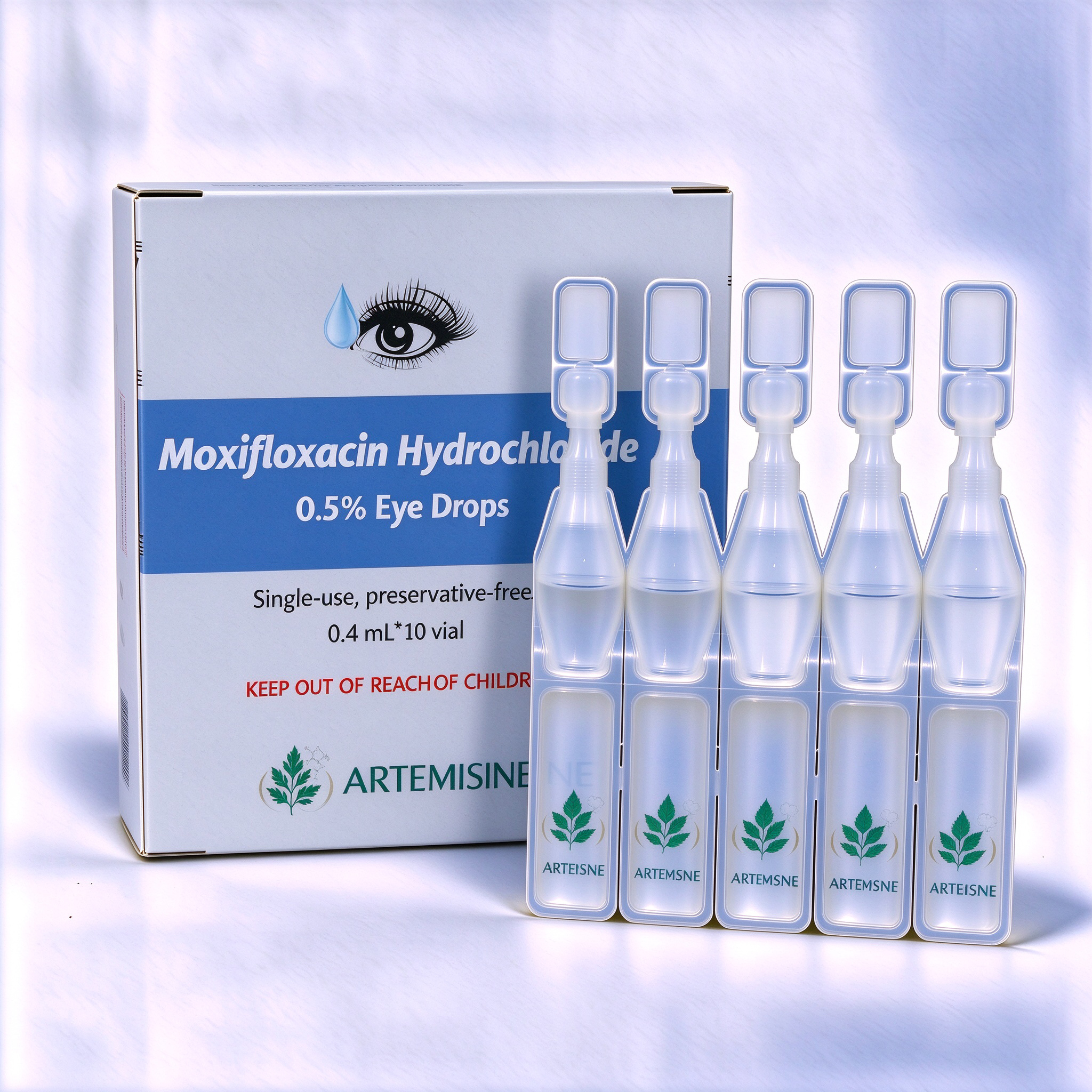
Moxifloxacin Hydrochloride Eye Drops 0.5% (5 mg/mL) 0.4 mL

● Moxifloxacin is a fourth-generation 8-methoxy fluoroquinolone anti-infective for topical ophthalmic use [1][2] ● It inhibits bacterial to

Moxifloxacin Hydrochloride Eye Drops 0.5% (5 mg/mL) 0.4 mL product packaging
Ophthalmic

Moxifloxacin Hydrochloride Eye Drops 0.5% (5 mg/mL) 0.4 mL

● Moxifloxacin is a fourth-generation 8-methoxy fluoroquinolone anti-infective for topical ophthalmic use [1][2]
● It inhibits bacterial topoisomerase II (DNA gyrase) and topoisomerase IV, the enzymes required for bacterial DNA replication, transcription, repair and partitioning [1][2]
● There is no cross-resistance with macrolides, aminoglycosides or tetracyclines, whereas cross-resistance has been observed between moxifloxacin and some other quinolones [1]
● One mL of the registered UK solution contains 5.45 mg moxifloxacin hydrochloride equivalent to 5 mg moxifloxacin, and each eye drop contains about 190 micrograms of moxifloxacin [2]
● Clear, colourless to greenish-yellow sterile ophthalmic solution, moxifloxacin 0.5% (5 mg/mL), in 0.4 mL single-dose units (about 2 mg per unit) [1][2][3]
● Systemic exposure after ocular instillation is very low: mean steady-state Cmax was 2.7 ng/mL, roughly 1600 times lower than after a therapeutic 400 mg oral dose [1][2]

Product NameMoxifloxacin Hydrochloride Eye Drops 0.5% (5 mg/mL) 0.4 mL
Dosage FormOphthalmic
Strength0.5% (5 mg/mL) 0.4 mL
StandardsBP / ENTERPRISE
PackingCustomized per market requirement (bottle / blister / box)
DocumentsCOA, COPP, DMF, CTD Dossiers
MOQContact us for MOQ and current stock
Request Quotation › ← Back to Ophthalmic
WHO Prescribing Guidance

Indications · Administration · Dosage · Precautions

Reference information summarised from WHO prescribing guidance. Expand each item below — clinical use must always follow the locally approved product insert.

🎯Indications▾
● US reference: bacterial conjunctivitis caused by susceptible strains, including aerobic Gram-positive organisms (Corynebacterium spp., Micrococcus luteus, Staphylococcus aureus, S. epidermidis, S. haemolyticus, S. hominis, S. warneri, Streptococcus pneumoniae and the viridans group), aerobic Gram-negative organisms (Acinetobacter lwoffii, Haemophilus influenzae, H. parainfluenzae) and Chlamydia trachomatis [1] ● UK reference: topical treatment of purulent bacterial conjunctivitis caused by moxifloxacin susceptible strains [2]
💧Administration▾
● For ocular use only; instil one drop into the conjunctival sac of the affected eye [1][2][3] ● Not for injection: do not inject subconjunctivally and do not introduce the solution directly into the anterior chamber of the eye [1][2] ● Wash hands before use; do not allow the dropper tip to touch the eye, fingers, face or any other surface [2][3] ● After instillation, close the eye for 2–3 minutes and press gently on the tear duct; holding the nasolacrimal ducts closed for 2–3 minutes is especially important in new-born infants and children [2][3] ● If more than one topical ophthalmic product is used, administer them at least 5 minutes apart; eye ointments should be applied last [2][3] ● Do not wear contact lenses while there are signs and symptoms of bacterial ocular infection [1][2][3] ● Discard the UK multi-dose bottle 4 weeks after first opening (no special storage conditions; shelf life 3 years); the US reference is stored at 2–25 °C [1][2]
⚖️Dosage▾
The schedule below refers to registered moxifloxacin 0.5% ophthalmic products; for the single-dose presentation, instil the volume and frequency prescribed in the approved label of the product concerned [1][2]
⚠️Precautions & Warnings▾
● Contraindicated in patients with a history of hypersensitivity to moxifloxacin, to other quinolones, or to any component of the product [1][2] ● Serious and occasionally fatal hypersensitivity (anaphylactic) reactions have been reported in patients receiving systemically administered quinolones, some following the first dose; discontinue use if an allergic reaction occurs, and institute emergency treatment as clinically indicated [1][2] ● As with other anti-infectives, prolonged use may result in overgrowth of non-susceptible organisms, including fungi; if superinfection occurs, discontinue use and institute alternative therapy [1][2] ● Tendon inflammation and rupture have been reported with systemic fluoroquinolone therapy, particularly in older patients and those treated concurrently with corticosteroids; caution should be exercised and treatment discontinued at the first sign of tendon inflammation [2] ● The product should not be used for the prophylaxis or empiric treatment of gonococcal conjunctivitis, including gonococcal ophthalmia neonatorum, because of fluoroquinolone-resistant Neisseria gonorrhoeae; gonococcal eye infections require appropriate systemic treatment [2] ● UK reference: not recommended for conjunctivitis in neonates or for Chlamydia trachomatis infection in patients under 2 years of age; US reference: safety and effectiveness in infants below 1 year of age have not been established [1][2] ● Pregnancy: US label (Category C) — use only if the potential benefit justifies the potential risk to the fetus [1]; UK SmPC — can be used, as systemic exposure is negligible [2]; breast-feeding: use with caution (US) [1], can be used (UK) [2] ● Driving: negligible influence on driving and using machines; if transient blurred vision occurs, wait until vision clears [2][3] ● Drug interactions: no specific interaction studies exist; interactions are unlikely given the low systemic concentrations after ocular use, and moxifloxacin does not inhibit CYP3A4, CYP2D6, CYP2C9, CYP2C19 or CYP1A2 [1][2] ● Adverse reactions: the most frequent ocular events are eye irritation and eye pain (1–2% in UK studies; 1–6% in the US label) together with conjunctivitis, decreased visual acuity, dry eye, keratitis, ocular discomfort, hyperaemia, pruritus, subconjunctival haemorrhage and tearing; uncommon reactions include punctate keratitis, eyelid oedema and ocular itching, and rare events include endophthalmitis, ulcerative keratitis and increased intraocular pressure; non-ocular events (fever, cough, infection, otitis media, pharyngitis, rash, rhinitis) occurred in 1–4% [1][2] ● Storage: US reference — store at 2–25 °C [1]; UK reference — no special storage conditions, discard 4 weeks after first opening, shelf life 3 years [2]; MedlinePlus — keep in the original container tightly closed, at room temperature, away from excess heat and moisture and out of the reach of children [3] For full prescribing information, refer to the approved product label / Summary of Product Characteristics of the product concerned [1][2][3].

Reference: WHO Model Formulary / WHO Model List of Essential Medicines. For professional reference only — clinical use must follow the locally approved product insert and national treatment guidelines.

Why Order From Us

Factory Direct. Fully Documented.

🛡️

GMP Quality

Full batch testing and quality traceability under standard GMP workshops.

🚢

Fast Delivery

Sufficient stock on regular items, familiar with export logistics to 50+ countries.

📑

Registration Support

COA, DMF, dossier and legalization documents for your market registration.

FAQ

Moxifloxacin Hydrochloride Eye Drops 0.5% (5 mg/mL) 0.4 mL — Frequently Asked Questions

Which documents are provided for Moxifloxacin Hydrochloride Eye Drops 0.5% (5 mg/mL) 0.4 mL registration?

Every batch of Moxifloxacin Hydrochloride Eye Drops 0.5% (5 mg/mL) 0.4 mL ships with a Certificate of Analysis (COA). For market registration we provide COPP, DMF and CTD-format dossiers, plus legalisation support where your authority requires it.

What is the MOQ and lead time for Moxifloxacin Hydrochloride Eye Drops 0.5% (5 mg/mL) 0.4 mL?

MOQ and lead time for Moxifloxacin Hydrochloride Eye Drops 0.5% (5 mg/mL) 0.4 mL depend on strength, packaging and destination market. Send us your target market and annual volume — our export team confirms current stock, MOQ and lead time within 24 hours.

Do you support OEM / private label?

Yes. We offer OEM packaging and private-label production for Moxifloxacin Hydrochloride Eye Drops 0.5% (5 mg/mL) 0.4 mL, subject to the regulatory requirements of the destination market.

Which markets have you exported ophthalmic products to?

We have supplied ophthalmic products to 50+ countries across Africa, Southeast Asia, Latin America and the Middle East, with experience in ministry-of-health registration and international tenders.

How is the quality of Moxifloxacin Hydrochloride Eye Drops 0.5% (5 mg/mL) 0.4 mL controlled?

Moxifloxacin Hydrochloride Eye Drops 0.5% (5 mg/mL) 0.4 mL is produced in China-GMP workshops (site re-inspected and passed in 2026), released only after full QC testing against BP / enterprise standards, with retained samples kept for one year beyond the product's expiry date.

Ask About This Product ›
✎ 💬 ↑
👋 Hi! I'm Care, your product guide. Tap me to ask about our medicines & APIs. ×
Care - product guide assistant