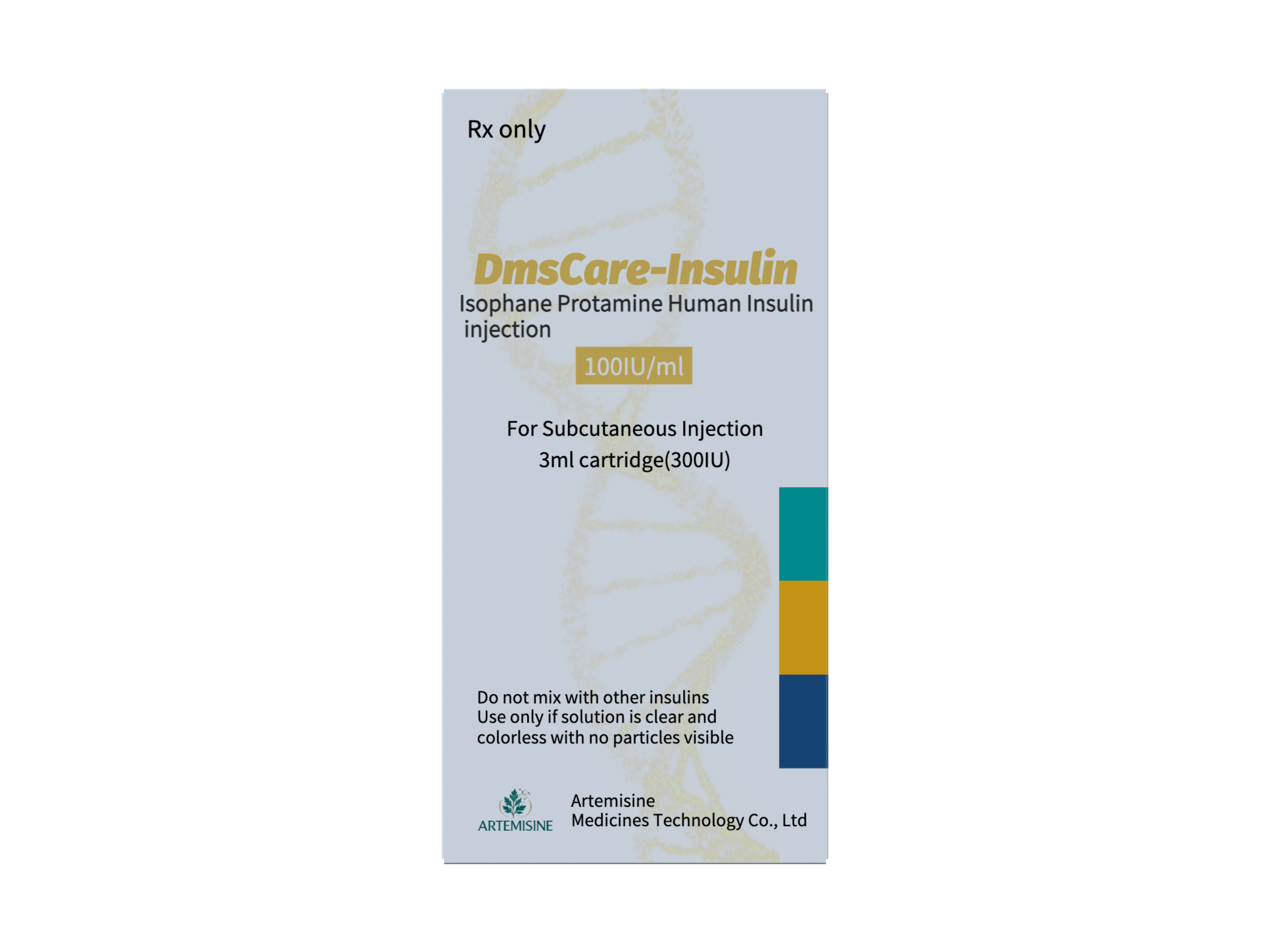
Isophane Protamine Human Insulin Injection 3 mL Cartridge

● Intermediate-acting human insulin (NPH / isophane insulin suspension) produced by recombinant DNA technology (Saccharomyces cerevisiae for

Isophane Protamine Human Insulin Injection 3 mL Cartridge product packaging
Injection

Isophane Protamine Human Insulin Injection 3 mL Cartridge

● Intermediate-acting human insulin (NPH / isophane insulin suspension) produced by recombinant DNA technology (Saccharomyces cerevisiae for the cartridge reference product) [1]
● Amino acid sequence identical to human insulin; in the US reference label it is a suspension of crystals of human insulin with protamine sulfate (molecular weight 5808) [2]
● Cloudy, white, aqueous suspension for subcutaneous injection; resuspend before use (a glass ball in the cartridge facilitates resuspension) [1][2]
● Each 1 mL contains 100 international units of isophane (NPH) insulin human (3.5 mg); each 3 mL cartridge contains 300 international units [1]
● Excipients: zinc chloride, glycerol, metacresol, phenol, disodium phosphate dihydrate, protamine sulfate and water for injections (pH adjusted with hydrochloric acid / sodium hydroxide) [1][2]
● Action profile: onset within about 1.5 hours, maximum effect at 4–12 hours, total duration approximately 24 hours — an intermediate-acting basal insulin [1]

Product NameIsophane Protamine Human Insulin Injection 3 mL Cartridge
Dosage FormInjection
Strength100 IU/mL
StandardsBP / ENTERPRISE
PackingCustomized per market requirement (bottle / blister / box)
DocumentsCOA, COPP, DMF, CTD Dossiers
MOQContact us for MOQ and current stock
Request Quotation › ← Back to Injection
WHO Prescribing Guidance

Indications · Administration · Dosage · Precautions

Reference information summarised from WHO prescribing guidance. Expand each item below — clinical use must always follow the locally approved product insert.

🎯Indications▾
● Treatment of diabetes mellitus [1] ● Indicated to improve glycaemic control in adult and paediatric patients with diabetes mellitus [2] ● May be used alone or mixed with fast-acting insulin, e.g. as basal insulin (evening and/or morning injection) with fast-acting insulin at meals in intensive insulin therapy [1] ● Can be used in children and adolescents [1]
💧Administration▾
● Administer subcutaneously only, in the thigh, abdominal wall, gluteal region or deltoid region [1][2] ● Rotate injection sites within the same region from one injection to the next to reduce the risk of lipodystrophy and cutaneous amyloidosis [1][2] ● Insulin suspensions are never to be administered intravenously, intramuscularly or via an insulin infusion pump [1][2] ● Resuspend before use: gently roll and invert the cartridge until uniformly white and cloudy; do not use if particulate matter or non-uniform cloudiness is seen; allow the cartridge to reach room temperature after removal from the refrigerator [1][2] ● Keep the needle under the skin for at least 6 seconds to ensure the full dose is injected; inject into a lifted skin fold to avoid unintended intramuscular injection [1] ● The cartridge is intended only for use with a compatible reusable pen; for syringe administration use a vial [1] ● Discard the needle after each injection; never share needles, syringes, cartridges or pens between patients; do not refill empty cartridges [1][2] ● Always check the insulin label before each injection to avoid accidental mix-ups with other insulin products [1][2]
⚖️Dosage▾
Dosing is individual and determined by the patient’s needs; the physician decides whether one or several daily injections are necessary [1]. Blood glucose monitoring is recommended for optimal glycaemic control [1]. ● Dose adjustment may be necessary with increased physical activity, changes in the usual diet, or during concomitant illness [1] ● Dosage adjustments may be needed with changes in meal patterns, changes in renal or hepatic function, or during acute illness [2] ● In elderly patients, glucose monitoring should be intensified and the dose adjusted on an individual basis [1]
⚠️Precautions & Warnings▾
● Hypoglycaemia is the most frequently reported adverse reaction of insulin therapy and may be severe, leading to unconsciousness, convulsions, temporary or permanent impairment of brain function or even death [1][2] ● Do not inject the product if hypoglycaemia is present or suspected; after stabilisation of blood glucose, dose adjustment should be considered [1] ● Warning symptoms of hypoglycaemia may change or disappear, especially in patients with longstanding diabetes or greatly improved glycaemic control; be cautious when driving or operating machinery [1][2] ● Never share a pen, cartridge, syringe or needle between patients, even if the needle is changed — sharing poses a risk of transmission of blood-borne pathogens [1][2] ● Medication errors: accidental mix-ups between insulin products have been reported; always check the insulin label before each injection [1][2] ● Hypersensitivity: generalised allergic reactions (skin rash, itching, sweating, angioneurotic oedema, difficulty breathing, palpitation, fall in blood pressure) are very rare but can be life-threatening; severe anaphylaxis can occur [1][2] ● Hypokalaemia may occur and may be life-threatening; monitor potassium in patients at risk and treat if indicated [2] ● Fluid retention and heart failure have been reported with concomitant use of thiazolidinediones (e.g. pioglitazone); observe for signs of heart failure and consider TZD dose reduction or discontinuation [1][2] ● Injection site reactions (pain, redness, hives, inflammation, bruising, swelling, itching) usually resolve within days to weeks; lipodystrophy and cutaneous amyloidosis may occur at the injection site and delay local absorption — rotate injection sites continuously [1][2] ● At the start of treatment, refraction anomalies, oedema and injection site reactions may occur, usually transitory; rapid glycaemic improvement may be associated with acute painful neuropathy, usually reversible [1] ● Pregnancy: there are no restrictions on insulin treatment during pregnancy, as insulin does not pass the placental barrier; intensified blood glucose control is recommended, with dose adjustment as requirements change [1] ● Breast-feeding: no restriction; the insulin dose may need to be adjusted [1] ● Storage: unopened cartridges — refrigerate at 2–8 °C, do not freeze. During use or when carried as a spare — store for a maximum of 6 weeks below 30 °C; do not refrigerate or freeze; keep the cartridge in the outer carton to protect from light; never use insulin that has been frozen [1] ● Use a new needle for each injection; keep the product out of the reach of children [1][2] For full prescribing information, refer to the approved product label / Summary of Product Characteristics of the product concerned [1][2].

Reference: WHO Model Formulary / WHO Model List of Essential Medicines. For professional reference only — clinical use must follow the locally approved product insert and national treatment guidelines.

Why Order From Us

Factory Direct. Fully Documented.

🛡️

GMP Quality

Full batch testing and quality traceability under standard GMP workshops.

🚢

Fast Delivery

Sufficient stock on regular items, familiar with export logistics to 50+ countries.

📑

Registration Support

COA, DMF, dossier and legalization documents for your market registration.

FAQ

Isophane Protamine Human Insulin Injection 3 mL Cartridge — Frequently Asked Questions

Which documents are provided for Isophane Protamine Human Insulin Injection 3 mL Cartridge registration?

Every batch of Isophane Protamine Human Insulin Injection 3 mL Cartridge ships with a Certificate of Analysis (COA). For market registration we provide COPP, DMF and CTD-format dossiers, plus legalisation support where your authority requires it.

What is the MOQ and lead time for Isophane Protamine Human Insulin Injection 3 mL Cartridge?

MOQ and lead time for Isophane Protamine Human Insulin Injection 3 mL Cartridge depend on strength, packaging and destination market. Send us your target market and annual volume — our export team confirms current stock, MOQ and lead time within 24 hours.

Do you support OEM / private label?

Yes. We offer OEM packaging and private-label production for Isophane Protamine Human Insulin Injection 3 mL Cartridge, subject to the regulatory requirements of the destination market.

Which markets have you exported injection products to?

We have supplied injection products to 50+ countries across Africa, Southeast Asia, Latin America and the Middle East, with experience in ministry-of-health registration and international tenders.

How is the quality of Isophane Protamine Human Insulin Injection 3 mL Cartridge controlled?

Isophane Protamine Human Insulin Injection 3 mL Cartridge is produced in China-GMP workshops (site re-inspected and passed in 2026), released only after full QC testing against BP / enterprise standards, with retained samples kept for one year beyond the product's expiry date.

Ask About This Product ›
✎ 💬 ↑
👋 Hi! I'm Care, your product guide. Tap me to ask about our medicines & APIs. ×
Care - product guide assistant