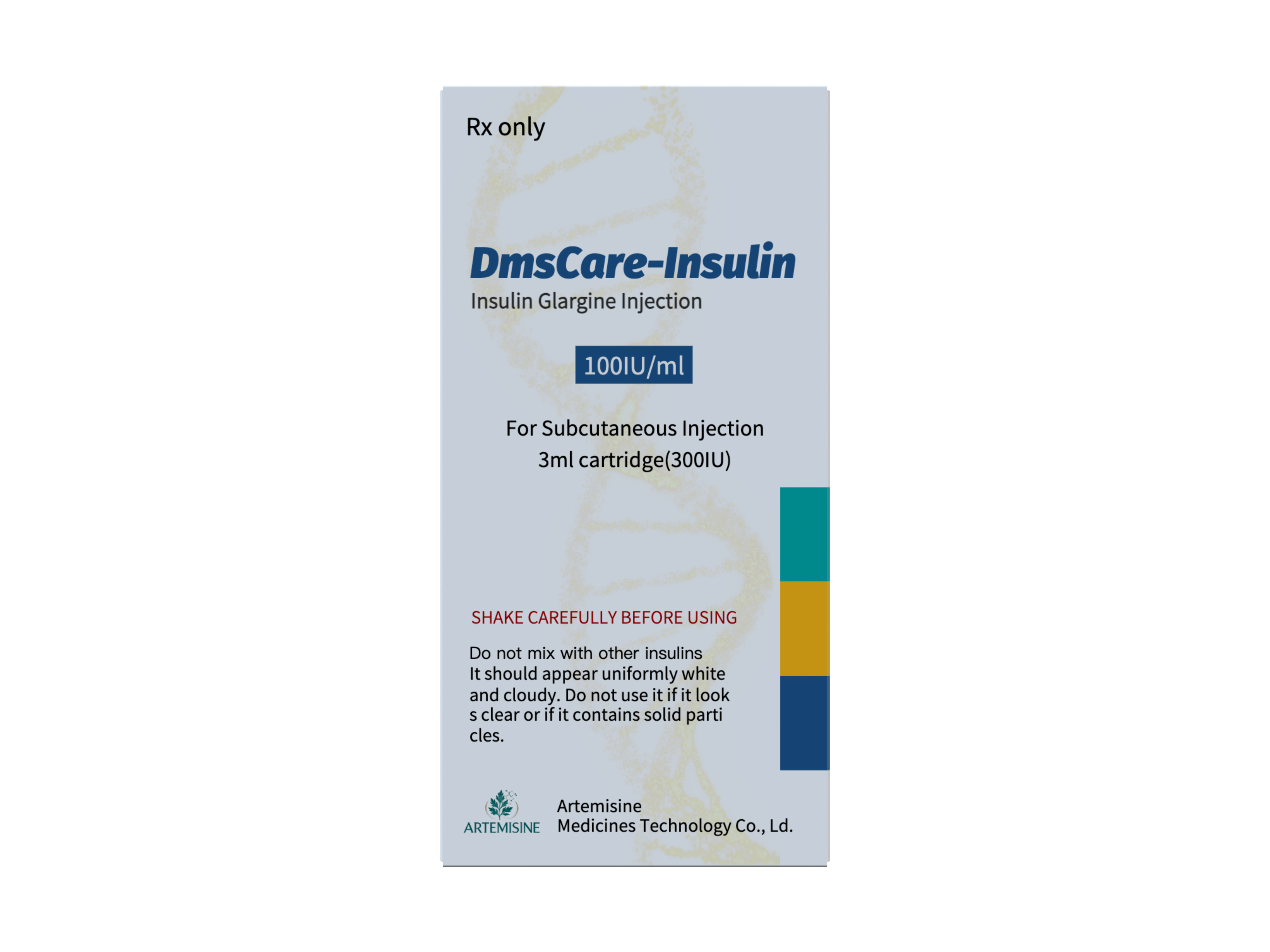
Insulin Glargine Injection 3 mL Cartridge

● Long-acting human insulin analogue produced by recombinant DNA technology in Escherichia coli [1][2] ● Differs from human insulin: aspara

Insulin Glargine Injection 3 mL Cartridge product packaging
Injection

Insulin Glargine Injection 3 mL Cartridge

● Long-acting human insulin analogue produced by recombinant DNA technology in Escherichia coli [1][2]
● Differs from human insulin: asparagine at position A21 is replaced by glycine, and two arginines are added to the B-chain C-terminus (molecular weight 6063 Da) [1]
● Clear, colourless solution for subcutaneous injection, pH approximately 4 [1][2]
● Each 1 mL contains 100 units (3.64 mg); each cartridge holds 3 mL (300 units) [1][2]
● Excipients: glycerol 85%, metacresol, zinc, and water for injections (pH adjusted with hydrochloric acid / sodium hydroxide) [1][2]
● Mechanism: after subcutaneous injection the acidic solution is neutralised, forming micro-precipitates from which insulin is continuously released — giving a smooth, peakless profile with a prolonged duration of action [2]
● Steady-state levels are reached within 2–4 days of the first dose, supporting once-daily administration [2]

Product NameInsulin Glargine Injection 3 mL Cartridge
Dosage FormInjection
Strength100 IU/mL 3ml cartidge
StandardsBP / ENTERPRISE
PackingCustomized per market requirement (bottle / blister / box)
DocumentsCOA, COPP, DMF, CTD Dossiers
MOQContact us for MOQ and current stock
Request Quotation › ← Back to Injection
WHO Prescribing Guidance

Indications · Administration · Dosage · Precautions

Reference information summarised from WHO prescribing guidance. Expand each item below — clinical use must always follow the locally approved product insert.

🎯Indications▾
● Improvement of glycaemic control in adults, adolescents and children aged 2 years and above with diabetes mellitus [1][2] ● In type 2 diabetes mellitus, insulin glargine can be used together with orally active antidiabetic medicinal products [2] ● Not recommended for the treatment of diabetic ketoacidosis — regular insulin administered intravenously is recommended in such cases [1][2]
💧Administration▾
● Administer subcutaneously once daily at any time of day, but at the same time every day [1][2] ● Inject into the abdominal area, thigh or deltoid; these sites are clinically equivalent [1][2] ● Rotate injection sites within the same region from one injection to the next to reduce the risk of lipodystrophy and cutaneous amyloidosis; do not inject into affected areas [1][2] ● Do not administer intravenously or via an insulin pump — intravenous administration of the usual subcutaneous dose could result in severe hypoglycaemia [1][2] ● Do not dilute or mix with any other insulin or solution; mixing or diluting can change the time/action profile and can cause precipitation [1][2] ● The cartridge is intended only for use with a compatible reusable pen; for syringe administration use a vial [2] ● Inspect the solution before use: use only if clear, colourless, free of visible particles and of water-like consistency; as a solution it does not require resuspension [2] ● Keep the cartridge at room temperature for 1–2 hours before insertion into the pen; remove air bubbles before injection; do not refill empty cartridges [2]
⚖️Dosage▾
The dose of insulin glargine must be individualised and adjusted based on the patient’s metabolic needs, blood glucose monitoring results and glycaemic control goal; dosage changes should be made only under medical supervision with appropriate glucose monitoring [1][2]. ● In type 1 diabetes, insulin glargine must be used together with short-acting (mealtime) insulin [1] ● Insulin requirements may be diminished in elderly patients, in renal impairment and in hepatic impairment [2] ● Dose adjustments may be needed with changes in physical activity, meal patterns, acute illness, or changes in renal or hepatic function [1] ● When switching from other insulins, adjust the basal dose and concomitant antidiabetic treatment as needed, with close metabolic monitoring during and after the switch [2] ● Potency is expressed in units that are exclusive to this product and are not the same as IU or the units of other insulin analogues [2]
⚠️Precautions & Warnings▾
● Hypoglycaemia is the most common adverse reaction of insulin therapy and may be severe and life-threatening; the long-acting effect of insulin glargine may delay recovery from hypoglycaemia [1][2] ● With insulin glargine, less nocturnal but more early-morning hypoglycaemia can be expected; warning symptoms may be diminished or absent in some patients [2] ● Never share a pen, insulin syringe or needle between patients, even if the needle is changed — sharing poses a risk of transmission of blood-borne pathogens [1] ● Medication errors: accidental mix-ups between insulin products have been reported; always check the insulin label before each injection [1][2] ● Hypersensitivity: severe, life-threatening generalised allergy, including anaphylaxis, can occur; immediate-type allergic reactions to insulin are rare but may be life-threatening (generalised skin reactions, angio-oedema, bronchospasm, hypotension and shock) [1][2] ● Hypokalaemia may occur and may be life-threatening; monitor potassium in patients at risk and treat if indicated [1] ● Fluid retention and heart failure have been reported with concomitant thiazolidinedione (e.g. pioglitazone) use; observe for heart failure and consider TZD dose reduction or discontinuation [1][2] ● Lipodystrophy and cutaneous amyloidosis may occur at the injection site and delay local absorption; continuous rotation of injection sites helps reduce these reactions [1][2] ● Common adverse reactions include hypoglycaemia, injection-site reactions (redness, pain, itching, hives, swelling, inflammation — usually resolving within a few days to weeks), weight gain, allergic reactions, lipohypertrophy, pruritus, rash and oedema [1][2] ● Pregnancy: large amounts of data (> 1000 pregnancy outcomes) indicate no specific adverse effects of insulin glargine; use may be considered during pregnancy if clinically needed, with careful monitoring of glycaemic control [2] ● Insulin requirements may change during pregnancy and breast-feeding; adjust the insulin dose and diet accordingly [2] ● Storage: unopened cartridges — refrigerate at 2–8 °C, do not freeze, keep in the outer carton to protect from light. After first use — the cartridge may be stored for a maximum of 4 weeks not above 30 °C, away from direct heat and light; do not refrigerate the pen containing a cartridge; put the pen cap back on after each injection [2] ● Use a new needle for each injection; keep the product out of the reach of children [1][2] For full prescribing information, refer to the approved product label / Summary of Product Characteristics of the product concerned [1][2].

Reference: WHO Model Formulary / WHO Model List of Essential Medicines. For professional reference only — clinical use must follow the locally approved product insert and national treatment guidelines.

Why Order From Us

Factory Direct. Fully Documented.

🛡️

GMP Quality

Full batch testing and quality traceability under standard GMP workshops.

🚢

Fast Delivery

Sufficient stock on regular items, familiar with export logistics to 50+ countries.

📑

Registration Support

COA, DMF, dossier and legalization documents for your market registration.

FAQ

Insulin Glargine Injection 3 mL Cartridge — Frequently Asked Questions

Which documents are provided for Insulin Glargine Injection 3 mL Cartridge registration?

Every batch of Insulin Glargine Injection 3 mL Cartridge ships with a Certificate of Analysis (COA). For market registration we provide COPP, DMF and CTD-format dossiers, plus legalisation support where your authority requires it.

What is the MOQ and lead time for Insulin Glargine Injection 3 mL Cartridge?

MOQ and lead time for Insulin Glargine Injection 3 mL Cartridge depend on strength, packaging and destination market. Send us your target market and annual volume — our export team confirms current stock, MOQ and lead time within 24 hours.

Do you support OEM / private label?

Yes. We offer OEM packaging and private-label production for Insulin Glargine Injection 3 mL Cartridge, subject to the regulatory requirements of the destination market.

Which markets have you exported injection products to?

We have supplied injection products to 50+ countries across Africa, Southeast Asia, Latin America and the Middle East, with experience in ministry-of-health registration and international tenders.

How is the quality of Insulin Glargine Injection 3 mL Cartridge controlled?

Insulin Glargine Injection 3 mL Cartridge is produced in China-GMP workshops (site re-inspected and passed in 2026), released only after full QC testing against BP / enterprise standards, with retained samples kept for one year beyond the product's expiry date.

Ask About This Product ›
✎ 💬 ↑
👋 Hi! I'm Care, your product guide. Tap me to ask about our medicines & APIs. ×
Care - product guide assistant